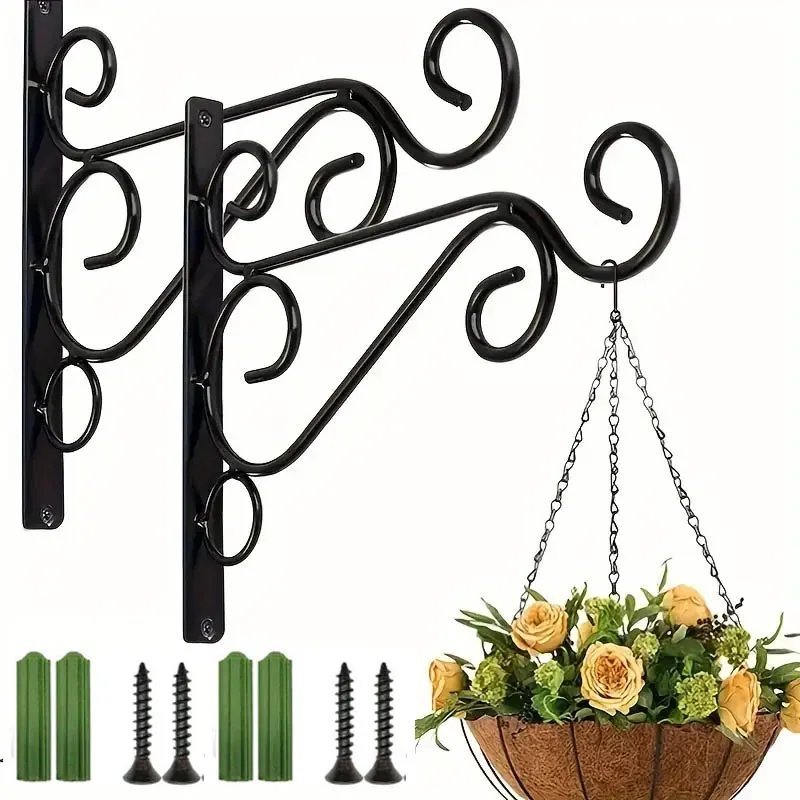
A bracket suits a solid wall where you want the basket to hang clear, a flat-backed wall basket suits narrow spaces and fences, and a hook suits anywhere with something overhead. On render, timber or a rented wall, choose the option that puts least leverage on the fixing.
Four ways to get a basket onto a wall, and the right one depends more on the wall than on the basket.
The four options
A bracket, which creates an overhang on a flat wall so a round basket can hang clear.
A flat-backed wall basket, which fixes directly to the face and does not swing.
A hook, where there is already something overhead - a beam, a soffit, a porch.
No-drill options, which hook over a rail or a fence top and take light loads only.
Identify the wall first
This decides everything else, and it is the step people skip.
Solid brick or stone takes anything, with the right plugs.
Render or pebbledash over block needs fixings long enough to reach past the surface layer into solid material.
Timber - cladding, posts, sheds takes screws directly, no plugs, but flexes more than masonry.
Fence panels flex badly and should carry only light, flat-backed loads - the fixings guide covers each properly.
Leverage is the thing to understand
A bracket holds the basket out on an arm, and that arm multiplies the pull on the fixing. The longer the reach, the greater the multiplication.
A flat-backed basket holds the load close to the wall with far less leverage, which is why it is the safer option on render, timber or anything you are unsure about - the wall basket guide covers them.
Working out the load
No arithmetic needed. Plant the basket, water it thoroughly, let it drain, then lift it.
That is what the fixing has to hold, and it is usually more than people expect. Choose hardware rated comfortably above it rather than at it - the brackets guide covers the numbers.
Reach, for a bracket
The basket must hang clear of the wall. As a working rule the projection wants to be more than half the basket's diameter.
Too short and the basket rests on the wall, crushing planting on one side and marking the render. Too long and it looks awkward and strains the fixing unnecessarily.
Two fixing points, not one
The single most useful rule in the whole subject.
One screw takes the entire load in one place and lets the bracket rotate slightly under weight, which works it loose over a season. Two or three in a vertical line stop rotation and share the pull - the brackets range covers plated designs.
Drilling masonry properly
Drill into brick rather than mortar joints, since brick holds a plug far better. Use the bit size the plug specifies rather than the one already in the drill.
Go deep enough that the plug sits fully below the surface, and blow the dust out before inserting it - dust is what stops a plug gripping.
Fixing into timber
Long screws straight into solid wood, no plugs, with a pilot hole slightly narrower than the shank.
Skipping the pilot hole splits the timber, and that split is what fails a year later. Fix into a post or a rail rather than into thin cladding boards.
Getting it level
Fix the top hole loosely, set the bracket with a spirit level, then mark the second hole from the bracket itself rather than from a tape measure.
For a pair either side of a door, reference both from the door frame rather than from the ground, which is rarely level.
Height and clearance
High enough that nobody walks into it, low enough that you can water it.
Those two pull against each other, which is why so many baskets end up too high to maintain. If it has to be high, plan the watering first - the watering can guide covers reaching one.
Rented walls and no-drill routes
Over-fence hooks, rail planters and freestanding stands all avoid drilling entirely.
They carry less, so they suit small baskets and artificial displays rather than a large watered one - the stands range and the hanging planters range cover both.
Finish, and where rust starts
At the wall plate, where water sits and where the coating usually gets scratched during fitting.
Powder-coated and galvanised outlast painted finishes considerably. A dab of paint over a fitting scratch is worth the minute - the hooks range faces the same weather.
Check it after the first month
Worth doing once, early. Fixings bed in, and a month of watered weight tells you whether the wall is really holding.
Push and pull it firmly, look for movement or cracking around the fixings, and deal with anything you find before the season rather than after a failure.
If the wall is the problem
Do not use the wall. A stand takes the load into the ground, needs no fixing at all, and can be moved - which suits rented properties, unknown walls and patios.
The stands range covers the sizes, and the fixings guide covers the alternative if you decide to use the wall after all.
Or take the weight out
Most of a basket's weight is water. An artificial display has none, weighs a fraction of a planted one and never gets heavier after rain - which on a doubtful wall is a genuine structural advantage.
The artificial range covers those, with free UK delivery over £20.
The short version
- Identify the wall before choosing the hardware - it decides everything else.
- A bracket's arm multiplies the pull; a flat-backed basket barely does at all.
- Water the basket, let it drain, lift it - that is the load the fixing must hold.
- Two or three fixing points stop the rotation that works a single screw loose.
- Drill into brick not mortar, and blow the dust out before inserting the plug.
Frequently asked questions
How do I fix a hanging basket to a wall?
With a bracket on a solid wall, a flat-backed wall basket in a narrow space or on a fence, or a hook where there is already something overhead. Which one depends mostly on what the wall is made of.
Which is safer, a bracket or a wall basket?
A wall basket, generally. A bracket holds the load out on an arm which multiplies the pull on the fixing, where a flat-backed basket keeps it close to the wall with far less leverage.
How far should a bracket project?
More than half the basket's diameter, as a working rule. Too short and the basket rests on the wall, crushing planting and marking render; too long and it strains the fixing unnecessarily.
Can I fix a basket to a fence?
To a post or a rail, yes. Not to the thin panel boards, which flex under load. A flat-backed wall basket is the right choice on a fence because it does not swing the way a bracketed one does.
What if I cannot drill the wall?
Use an over-fence hook, a rail planter or a freestanding stand. All avoid drilling entirely, but they carry less - so pair them with a small basket or an artificial display rather than a large watered one.