Quick answer: For baskets above head height, a long-spout can or a watering lance that attaches to a hose is what works. The limiting factor is weight - a full large can is heavy to hold at arm's length, so two smaller cans often beat one big one.
Watering a basket at ground level needs no special equipment. Watering one above your head is where most people discover their can is the wrong shape.
The actual problem
A basket above head height needs water delivered upward and inward, past the foliage and onto the compost.
An ordinary can tipped up at arm's length pours most of the water down your sleeve and the rest onto the leaves rather than the compost. That is not a technique problem, it is a spout-length problem.
Long-spout cans
The straightforward fix. A long, gently angled spout lets you reach over the rim from below and deliver water where it needs to go while the can stays lower than the basket.
They are usually smaller in capacity than a garden can, which turns out to be a feature rather than a limitation - the watering range covers them.
The weight problem
The point nobody mentions and the one that decides whether you keep doing this in August.
Water is heavy, and holding a full can out at arm's length above your head is a genuinely demanding thing to do repeatedly. A large can that is easy to carry is difficult to pour from at height.
Two smaller cans, or one filled halfway, is usually the better arrangement - more trips to the tap, far less strain.
Watering lances
The step up, and the answer if you have several baskets.
A lance is a rigid extension on a hose with a shut-off at the handle. You stand comfortably, reach up, deliver water precisely, and never lift any weight at all - the hose carries it.
The trade is that it needs an outside tap and a hose run, so it suits a garden rather than a balcony.
Pulleys as an alternative
Rather than getting water up to the basket, bring the basket down to the water.
A pulley or rise-and-fall hook lets a high basket be lowered to chest height for watering and raised again afterwards. It also makes deadheading and feeding straightforward, which is otherwise the reason high baskets get neglected.
The watering systems guide compares the options, and the hooks range covers hardware.
Drip systems
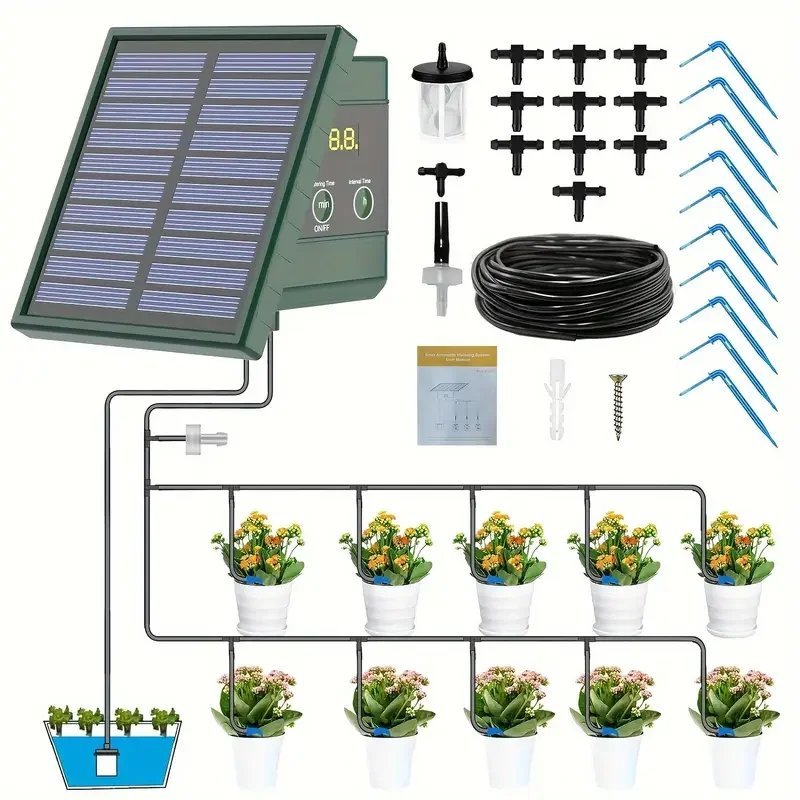
The end point for anyone with four or more baskets. A pipe run, small drippers at each basket, and a timer.
Installation is an afternoon and the running cost is nothing. Once it is in, watering stops being a job at all - the solar drip kit is the version that needs no socket.
What to look for in a can
- Spout length, which is the whole point - a short spout defeats the purpose.
- Balance when full, since a badly balanced can is exhausting at height.
- A rose that comes off, so you can water compost directly rather than sprinkling leaves.
- A comfortable handle, ideally one you can grip two ways.
- Capacity you can actually lift at arm's length, not the biggest available.
Rose on or off
Off, for baskets. A rose spreads water over foliage, which is what you want for seedlings and not what you want for a basket - the basket range covers the containers themselves.
Water goes on the compost, at the base of the plants, where the roots are. Wetting foliage in strong sun does nothing useful and can encourage problems on some plants - the liners range covers what holds that compost in place.
How to actually water a basket
Slowly, and twice. Dry compost repels water at first, so a single fast pour runs straight down the inside of the liner and out of the bottom without wetting anything.
Water a little, wait thirty seconds for it to soak in, then water again properly. That second pass is what actually reaches the roots - the care guide covers the routine in full.
When to water
Early morning is best, evening is second best, midday is worst because most of it evaporates before it does anything.
Check by weight rather than by schedule. Lift the basket slightly - a light basket needs water and a heavy one does not, whatever the calendar says.
Water butts and free water
Baskets take a lot of water through summer and rainwater is free, softer and preferred by most plants.
A butt near the baskets is a sensible investment, and the watering range covers the kit. A small pump or solar kit lets it feed a drip system without a tap - the self-watering guide covers reservoir arrangements.
Ladders
Worth saying plainly: watering from a ladder while holding a full can is how people fall.
If a basket can only be watered from a ladder, the answer is a lance, a pulley or a drip line - not better balance. Hang baskets where you can reach them, or add the kit that makes reaching unnecessary.
Or take watering off the list
An artificial display needs none of this, which for a high or awkward basket is the honest answer to the whole problem - the artificial range covers those, with free UK delivery over £20.
The short version
- Spout length is the whole point - an ordinary can at arm's length waters your sleeve.
- A full large can is hard to hold overhead; two small cans beat one big one.
- A lance on a hose means you lift no weight at all, which is the real upgrade.
- Take the rose off - water goes on compost, not on foliage.
- Water twice with a pause, because dry compost repels the first pour.
Frequently asked questions
What kind of watering can is best for hanging baskets?
One with a long, gently angled spout, so you can reach over the rim from below while the can stays lower than the basket. Capacity matters less than spout length and balance when full.
Should I use the rose?
No, take it off. A rose spreads water over foliage, which suits seedlings. A basket wants water delivered onto the compost at the base of the plants, where the roots actually are.
Why does water run straight through my basket?
Dry compost repels water at first, so a fast pour runs down the inside of the liner and out of the bottom. Water a little, wait thirty seconds, then water again properly - the second pass is what soaks in.
What if I cannot reach the basket?
Use a watering lance on a hose, or fit a pulley hook so the basket lowers to chest height. Do not water from a ladder holding a full can - that is how people fall.
When is the best time to water?
Early morning, with evening second best. Midday is worst because much of it evaporates before reaching the roots. Check by weight rather than by schedule - lift the basket, and a light one needs water.