Quick answer: Petunias want full sun, regular feeding and consistent water, and they will flower until the frosts if deadheaded. Trailing types and surfinias are the ones bred for baskets - upright bedding petunias will not spill over the edge.
If there is one plant the British hanging basket is built around, it is this one. It is also the one most often planted in the wrong place.
Petunias, surfinias and calibrachoa
Worth untangling, because the names are used loosely.
Petunias covers the whole group, including upright bedding types that do not trail at all.
Surfinias are trailing petunias bred specifically for baskets - vigorous, long-stemmed and the ones you actually want.
Calibrachoa, sold as million bells, look like tiny petunias and are self-cleaning, meaning they drop spent flowers themselves.
For a basket, buy trailing types. An upright bedding petunia in a basket sits there looking like it is in the wrong container, because it is.
They want sun
The single thing that decides whether this works. Petunias are sun plants and they want as much of it as your spot can give - six hours or more.
In part shade they will grow and flower sparsely. In real shade they stretch, go leggy and barely flower at all, and no amount of feeding changes it. If your spot is shady, plant begonias instead - the best plants guide covers those.
Water consistently
Petunias are thirsty, and a basket full of them in July is one of the fastest-drying things in a garden.
The problem is not just quantity but consistency - a plant that dries out hard and then gets soaked repeatedly sulks and drops buds. Daily watering in summer, twice daily in a heatwave, and check by weight rather than by looking - the care and watering guide covers the routine.
Feed them, properly
This is where most petunia baskets fall down in August.
They flower enormously and that costs the plant, so the goodness in a basket's small volume of compost runs out around six weeks after planting. From then on, a high-potash liquid feed every week or two is what keeps flowers coming.
A basket that has stopped flowering in August is usually hungry rather than finished - the planting guide covers what to use.
Deadheading
Standard petunias need it; calibrachoa largely do not.
Pinch off the whole spent flower including the green seed pod behind it, not just the faded petals - leaving the pod means the plant puts energy into seed and slows down. Five minutes a week makes a visible difference by August.
Legginess, and what to do
By midsummer trailing petunias often go bare in the middle with all the flower at the ends. It looks like the plant is failing and it is simply what they do.
Cut the longest stems back by about a third. It looks brutal and the plant responds with fresh growth and a second flush within a couple of weeks. Doing this in early July rather than late August is the difference between a good September and a bare one.
Rain and weather
Large-flowered petunias mark badly in heavy rain - the blooms go translucent and mushy. Smaller-flowered types and calibrachoa cope far better.
In an exposed, wet spot the smaller-flowered varieties are the sensible choice, and a position with a little overhead shelter helps more than anything.
How many in a basket
Fewer than you think for surfinias, which are vigorous and will fill a basket from three or four plants. Standard trailing petunias need more.
Plant the sides as well as the top so growth comes from the whole basket rather than just the rim - the planting guide covers the order.
Overwatering, and what it looks like
Less common than underwatering with petunias and worth recognising, because the symptoms overlap.
A waterlogged basket gives you yellowing lower leaves, soft stems and a plant that wilts even though the compost is wet - which people then water again, making it worse.
Check the drainage holes are clear, check the liner is not holding a sealed pool in the base, and let it dry back before watering again - the liners range covers drainage.
The season
Plant out after the last frost, usually late May in most of the UK, and they will run until the first frost of autumn. They are annuals - there is no overwintering them outdoors.
Where we come in
We do not sell live plants - petunias come from a nursery or garden centre. We sell what they hang in and what keeps them there: baskets, liners, brackets and watering kit.
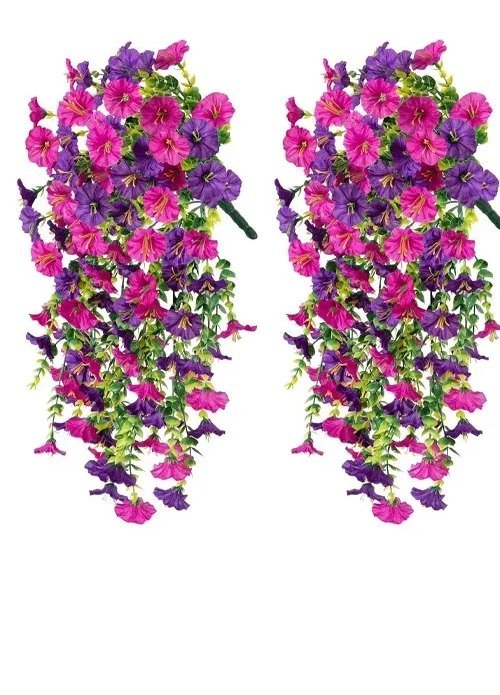
And for spots too shady or too awkward to water, artificial trailing petunias look the part all year - the artificial flowering range covers those.
The short version
- Buy trailing types or surfinias - upright bedding petunias will not spill at all.
- They need six hours of sun or more; in shade they stretch and barely flower.
- Consistency matters as much as quantity - drying hard then soaking makes them drop buds.
- Feed with high-potash every week or two from six weeks after planting.
- Cut leggy stems back by a third in early July for a second flush by September.
Frequently asked questions
Do petunias need full sun in a hanging basket?
Yes - six hours or more. In part shade they flower sparsely, and in real shade they stretch, go leggy and barely flower at all, which no amount of feeding will fix. Plant begonias in shade instead.
What is the difference between petunias and surfinias?
Surfinias are trailing petunias bred specifically for baskets - vigorous and long-stemmed. Petunias as a group include upright bedding types that do not trail, which look wrong in a basket.
Why has my petunia basket stopped flowering?
Usually hunger. Petunias flower enormously and exhaust a basket's small volume of compost about six weeks after planting, so they need a high-potash liquid feed every week or two from then on.
What do I do about leggy petunias?
Cut the longest stems back by about a third. It looks brutal and the plant responds with fresh growth and a second flush within a couple of weeks. Do it in early July rather than late August.
Do petunias survive rain?
Large-flowered types mark badly - the blooms go translucent and mushy. Smaller-flowered varieties and calibrachoa cope far better, so choose those for an exposed or wet position.