Quick answer: Trade counters are best for fixings and heavy-duty steel, DIY sheds for buying today, garden centres for decorative brackets, and online for range and for matching a bracket to a specific basket. What decides it is whether you already know the reach and load you need.
We sell brackets, so read this knowing that. I have tried to be fair about what each route is genuinely good at.
The question that decides where to go
Do you know the reach and the load you need?
If you do, buy wherever is convenient and cheapest. If you do not, buy somewhere that publishes the numbers - because a bracket bought on looks alone is the one that ends up too short for the basket - the brackets guide covers working those out.
Trade counters
Good for: fixings, above all. If you need the right plugs and screws for render, a cavity wall or timber, a trade counter has a proper range and staff who deal with it daily.
They are also strong on plain heavy-duty steel brackets, which are often sold as general-purpose shelf or sign brackets and work perfectly well for a basket.
Less good for: decorative styles. The range is functional rather than pretty, which is fine on a shed wall and less so on a period front.
DIY sheds
Good for: having it today, and buying the basket, the bracket, the compost and the fixings in one trip.
Less good for: depth of range. Shelf space limits what is stocked, heavy-duty options are often thin on the ground, and seasonal stock disappears out of season - trying to buy a basket bracket in November is frequently a wasted trip.
Garden centres
Good for: decorative brackets, and seeing the thing in your hand. Scrolled and ornamental styles are where they are strongest, and staff will often know which brackets suit which baskets they sell.
Less good for: price, generally, and for fixings, which tend to be an afterthought.
Online, including us
Good for: range and for published measurements. Nothing limits how many sizes and styles can be listed, and reach and load figures are written down rather than guessed at in an aisle.
It is also the only route where you can reliably match a bracket to a specific basket by numbers rather than by eye.
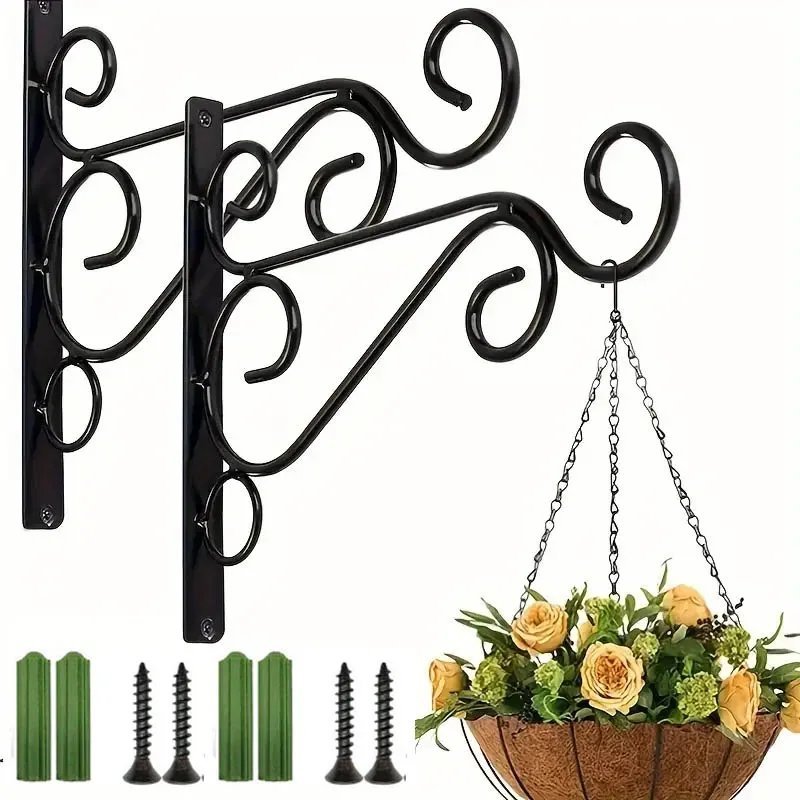
Less good for: having it in an hour, and for judging weight and finish quality without handling it - our brackets range and the heavy-duty pair are the two we stock.
What to check wherever you buy
- Reach, which should exceed half the basket's diameter.
- Rated load, comfortably above the watered weight.
- Number of fixing holes - two or three beats one for anything heavy.
- Finish - powder-coated or galvanised lasts far longer than painted.
- Whether fixings are included, and whether they suit your wall.
The fixings are usually the weak point
Worth saying plainly: the screws and plugs supplied in the box are generic, and they are sized for solid masonry.
If your wall is render over block, timber, or anything hollow, buy the fixings separately for that wall. This is the one part of the job where a trade counter genuinely earns its place, whoever you bought the bracket from - the fixings guide covers wall types.
Buying a pair
If you want two matching brackets either side of a door, buy them together and from the same batch. Finishes vary between production runs, and two brackets that are nearly the same colour look worse than two that are obviously different.
Second-hand and reclaimed
Reclaimed cast brackets look wonderful on an older house and are a legitimate buy, with two checks. Look for cracks in the casting, which cast iron hides well and fails at suddenly. And check the fixing holes are intact and unstretched.
Do not use anything with visible cracking for a heavy basket above a doorway.
What we do
For the sake of being straight about it: free UK delivery over £20 and a flat £5.99 below, dispatched within 48 hours Monday to Friday and arriving within 8 days, everywhere in the UK.
Thirty days to return anything, a full refund in money rather than credit, and we pay the return postage - the delivery page and the returns page have the detail.
Ordering the wrong size, and what it costs
Worth thinking about before choosing where to buy, because it is the commonest outcome of buying on looks.
A bracket too short for the basket means the basket rests against the wall, which crushes the planting on one side, marks the render and stops air moving round it. A bracket too long looks awkward and puts unnecessary leverage on the fixing.
Neither is dangerous. Both mean a second trip or a second order, which is why the reach figure is worth checking before rather than after - the heavy-duty brackets guide covers sizing at the top end.
Buying the basket and bracket together
The single practical habit that avoids all of it.
If you buy the basket first and the bracket weeks later, the diameter is a memory rather than a measurement and the reach ends up guessed. Bought together, the numbers are in front of you and the pair arrives matched.
It also means one delivery rather than two - the hooks range is worth adding if you are hanging from a beam rather than a wall.
The honest recommendation
Measure the basket first, then buy the bracket to those numbers from wherever stocks the size you need - and buy the fixings for your actual wall separately if the wall is anything other than solid brick.
Buying the bracket at the same time as the basket, rather than afterwards, avoids the single most common mistake in this whole area - the basket range and the brackets range are both here.
The short version
- The deciding question is whether you already know the reach and load you need.
- Trade counters are best for fixings; garden centres for decorative styles.
- DIY sheds are best for today, worst for range - and seasonal stock vanishes in winter.
- Supplied screws and plugs are generic and sized for solid masonry.
- Buy a matching pair together; finishes vary between production runs.
Frequently asked questions
Where is the best place to buy a hanging basket bracket?
It depends whether you know the reach and load you need. If you do, buy wherever is cheapest. If not, buy somewhere that publishes the numbers, because a bracket bought on looks is the one that ends up too short.
Are the screws in the box good enough?
For solid masonry, usually. Supplied fixings are generic and sized for brick, so if your wall is render over block, timber or anything hollow, buy fixings for that wall separately.
What should I check before buying?
Reach exceeding half the basket's diameter, a rated load comfortably above the watered weight, two or three fixing holes rather than one, a powder-coated or galvanised finish, and what fixings are included.
Should I buy brackets in a pair?
If you want two matching either side of a door, buy them together and from the same batch. Finishes vary between production runs, and two brackets that are nearly the same colour look worse than two clearly different ones.
Are reclaimed cast brackets safe to use?
They can be lovely on an older house, with two checks: look for cracks in the casting, which cast iron hides well and fails at suddenly, and check the fixing holes are intact and unstretched.