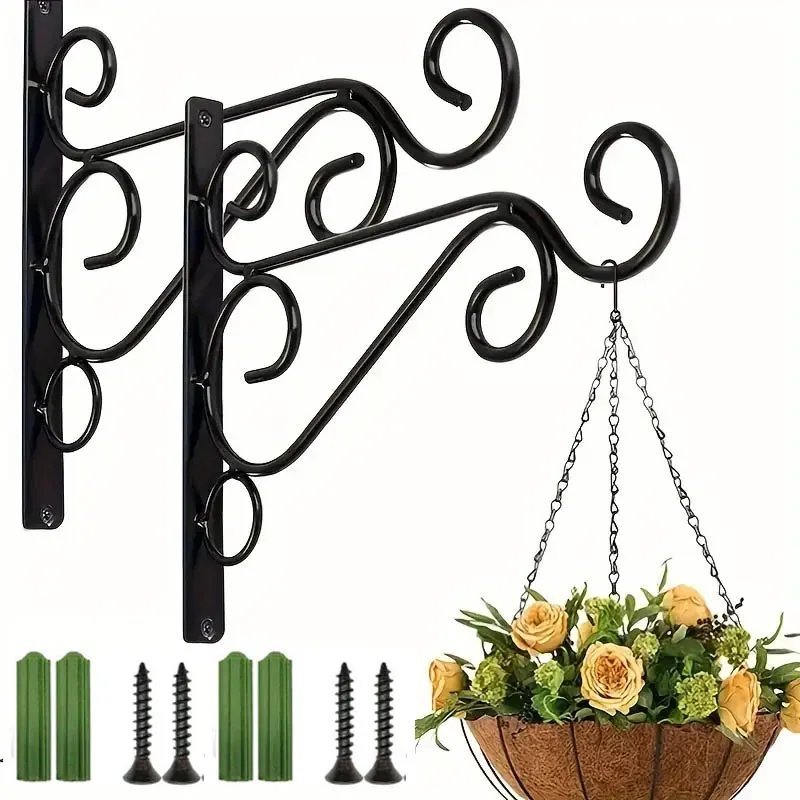
Most baskets can be raised by hooking a link further down the chain onto the ring, and lowered by adding an extension chain or S-hooks. Shorten all three or four chains by the same number of links, and check the basket hangs level before loading it.
The cheapest adjustment available and the one that most changes how a basket looks and how easy it is to look after.
Why chain length matters
Two reasons, and they pull against each other.
Appearance - a longer drop brings a basket down towards eye level where the planting is seen properly, and a shorter one keeps it tucked up out of the way.
Access - every centimetre lower is a centimetre closer to being able to water it without a ladder.
Raising a basket
The simplest adjustment and it needs no parts.
Unhook the top ring, take a link further down each chain, and hook that onto the ring instead. The surplus chain hangs above the ring, which is barely visible from below.
Count the links so all three or four are shortened identically - this is the step people get wrong.
Lowering a basket
Add an extension chain between the ring and the hook, or a series of S-hooks.
Extending above the ring rather than below the basket keeps the three chains equal and the basket level. Never lengthen just one chain to correct a tilt - the tilt is nearly always the hook, not the chain, and the hooks guide covers those.
Getting it level
Hang the empty basket and look at the rim from a few metres away, from two different angles.
A basket that is level empty stays level loaded, provided the planting is reasonably even. If it tilts, count links again before assuming anything is bent - the basket range covers replacements if the rim itself has distorted.
Three chains or four
Three is standard, hangs level readily and is easier to adjust. Four spreads the load slightly better on a large basket and is fiddlier to get even.
Either is fine. What matters is that they are the same length - the chains range covers replacements.
Chain quality
Frequently the weakest part of the whole arrangement, because it is the cheapest.
Check the gauge against the watered weight, that the end hooks close properly rather than being open C-shapes, and that the top ring is welded rather than simply bent round.
The hanging ring
Worth its own check. A ring that is bent round rather than welded can open under load, which is the failure nobody sees coming.
If yours is a bent ring, replacing it with a welded one or a rated split ring is a very cheap improvement - the buying checks guide covers what to look for.
Rope and cord instead
Lighter, quieter in wind, and it suits indoor and modern outdoor settings where chain looks industrial.
Check the rated load and that it is UV-stable if it is going outside, since untreated cord degrades in sunlight faster than people expect - the hanging planters range covers cord-hung options.
Swivels
A small addition worth knowing about. A swivel between the chain and the hook lets a basket turn freely, which means it fades and grows evenly rather than developing a shaded side.
It also lets you spin the basket round to water or deadhead the far side without unhooking it.
Pulleys, for a high basket
The proper solution when height is the reason a basket gets neglected.
A rise-and-fall hook lowers the basket to chest height for watering and feeding, then locks it back up. Check the rated load against a watered basket, since the mechanism carries all of it - the hooks range covers them.
Rust
Chains live outdoors with a wet basket dripping down them, so galvanised or powder-coated is worth having.
Rust usually starts at the end hooks where the coating wears against the ring. Check those specifically at the annual look rather than the middle of the chain - the artificial range puts far less strain on all of it, since there is no watered weight.
Clearance below
Remember that trailing growth adds length through the season. A basket that clears your head in May may not in August.
Allow for it when setting the drop, particularly over a path or a doorway - the hanging guide covers clearance.
Matching heights across a run
Set them from a fixed reference - a window head, a fence rail, a door frame - rather than measuring up from the ground, which is rarely level.
Two baskets that are nearly the same height look considerably worse than two that are obviously different, so it is worth the extra minute.
Replacing rather than adjusting
If the chains are rusted through, the hooks are opening or the ring is deformed, replace the set rather than nursing it.
Chains cost very little against a basket coming down - the brackets range and the chains range cover the hardware, with free UK delivery over £20.
The short version
- Raise a basket by hooking a lower link onto the ring - no parts needed.
- Lower it above the ring, not below the basket, so the chains stay equal.
- Count links: shortening three chains unequally is the usual cause of a tilt.
- A bent hanging ring can open under load; a welded one cannot.
- A swivel lets a basket turn, so it fades and grows evenly and is easier to water.
Frequently asked questions
How do I make a hanging basket hang lower?
Add an extension chain or S-hooks between the ring and the hook, above the basket rather than below it. That keeps the three or four chains equal in length so the basket still hangs level.
How do I raise a basket without new chains?
Unhook the top ring, take a link further down each chain and hook that on instead. The surplus hangs above the ring where it is barely visible - just count links so all chains match.
Why does my basket hang crooked?
Usually because the chains were shortened by different numbers of links, or because the hook itself is not level. Check the link count first, since a bent chain is far less common than a miscount.
Are three chains or four better?
Three is standard, hangs level readily and is easier to adjust. Four spreads the load slightly better on a large basket but is fiddlier to even up. Equal length matters more than the number.
What is a swivel for?
It sits between the chain and the hook and lets the basket turn freely, so it grows and fades evenly rather than developing a shaded side - and you can spin it to water the far side.