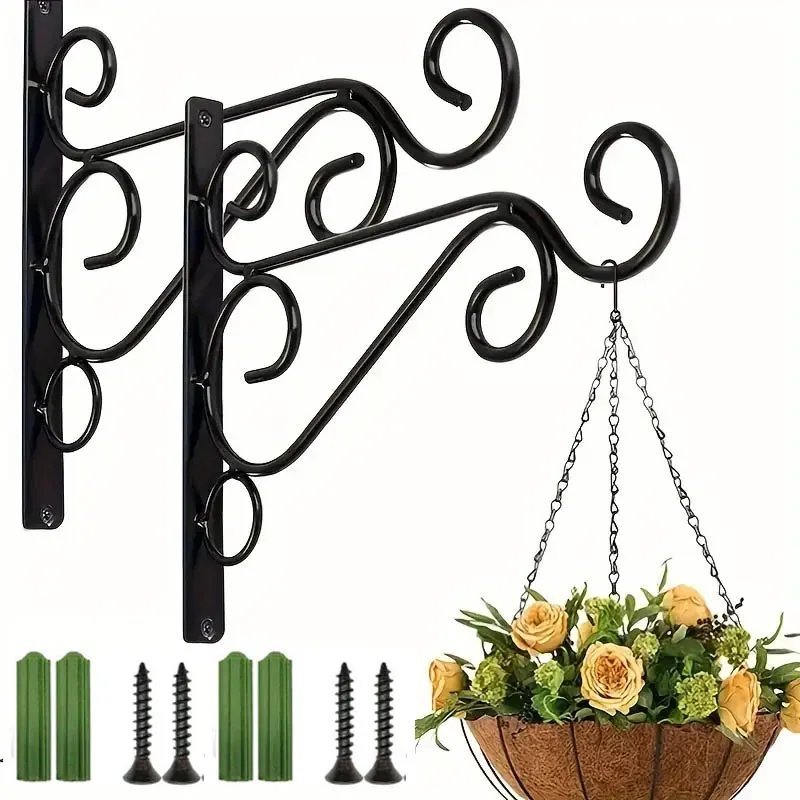
A wall or fence basket is a one-sided display, so put height at the back against the wall, mounding plants through the middle and trailers along the front edge only. Repeat the same scheme along a run rather than varying it, and expect to water more often than a round basket.
The planting logic changes when a basket has a wall behind it, and most disappointing wall baskets are planted as though they were round.
One-sided changes the layout
A round basket is planted from the centre outward and seen from every side. A wall basket is seen only from the front, which means the arrangement should be layered front to back rather than radially.
Height goes at the back, mounding plants fill the middle, and trailers go along the front edge alone - the wall basket guide covers the hardware side.
Nothing trailing at the back
The commonest mistake, and an easy one to make out of habit.
A trailing plant at the back has a wall to grow into, so it either presses against the render, holding damp against it, or grows forward through the display and unbalances it. Keep the back row upright.
The proportions that work
Roughly a third height at the back, a third filler through the middle, a third trailing at the front.
Heavier on the trailers if the basket is high up, since that is what is seen from below. Heavier on the height if it sits below eye level.
They dry out faster
A half-basket holds around half the compost of a round one of the same width, and a wall behind can reflect a surprising amount of heat.
Expect to water more often, mix water-retaining granules in at planting, and use a liner with a moisture-retaining backing - the liners range covers them.
Protect the wall behind
Water running down a wall marks render, stains brick and keeps a patch permanently damp.
Use a solid liner rather than an open back, water gently at the front rather than flooding, and if the wall is painted or rendered, accept that some staining is likely over years.
Fewer plants than you think
A half-basket takes roughly half what a round one of the same diameter would - so four or five in a 35cm wall basket rather than seven.
Overplanting is worse here than in a round basket because the compost volume is smaller and dries faster - the plant numbers guide covers the counts.
Schemes for a sunny wall
Upright geraniums at the back, mounding calibrachoa through the middle, trailing lobelia or bacopa at the front.
South and west walls get hot and reflect heat back at the planting, so drought-tolerant choices earn their place - the flowers guide covers sun and shade.
Schemes for a shady wall
Trailing fuchsias, begonias and busy lizzies all perform where flowering plants generally sulk.
North and east walls suit these far better than the sun-lovers everyone tries first - the fuchsias guide and the begonias guide cover both.
Foliage-only schemes
Underrated, and the most reliable option on a difficult wall. Heucheras, ivies, grasses and euonymus give a display that looks the same in November as in June.
No flowering season to miss, no deadheading, and it carries through winter without replanting.
Edible schemes
Wall baskets suit herbs particularly well, because they can sit at working height near a door.
Trailing thyme at the front, parsley and chives through the middle. Herbs generally want free drainage rather than constant moisture, so go easy on the water-retaining granules for these.
Runs along a fence
Where wall baskets look best. Three or five at one height, evenly spaced, planted identically.
Repetition is what reads as designed. Varying the scheme basket to basket reads as three separate ideas rather than one - the wall and fence range covers them.
Spacing along a run
Space them so the planting will just meet at maturity rather than overlapping, and set the heights from a level line off a rail or post rather than measuring up from the ground.
On a fence, fix into rails or posts, never into thin panel boards - the wall fixing guide covers this.
Seasonal changeover
Wall baskets are quicker to replant than round ones because there is no side planting to unpick.
September is the moment for autumn planting, while the compost is still warm - the autumn plants guide covers the season.
Feeding a one-sided display
Slightly different from a round basket, because the smaller compost volume runs out of nutrients sooner.
Mix slow-release granules in at planting, then start a high-potash liquid feed at around five weeks rather than six. Feed a damp basket rather than a dry one, since feed poured into dry compost mostly runs through without being taken up.
The compost and feed guide covers what to use.
Artificial in a wall basket
Particularly effective, because the wall-staining problem disappears with no watering, and a one-sided view is exactly what a faux display handles best.
The artificial range covers them, with free UK delivery over £20.
The short version
- Layer front to back, not radially - height at the back, trailers at the front only.
- Nothing trailing at the back; it presses against the wall and holds damp there.
- Half the compost of a round basket, so plant fewer and water more often.
- Repeat one scheme along a run - variation reads as separate ideas, not a design.
- Foliage-only schemes are the most reliable answer on a difficult wall.
Frequently asked questions
How should I plant a wall or fence basket?
As a one-sided display layered front to back: upright height at the back against the wall, mounding plants through the middle, and trailing plants along the front edge only.
Why should nothing trail at the back?
Because it has a wall to grow into. It either presses against the render, holding damp against the wall, or grows forward through the display and unbalances the whole arrangement.
How many plants go in a wall basket?
Around half what a round basket of the same diameter takes - four or five in a 35cm wall basket rather than seven. The compost volume is smaller and dries faster, so overplanting hurts more.
Will it mark the wall behind?
Probably, over years, because water runs down the wall. Use a solid liner rather than an open back and water gently at the front rather than flooding it, which reduces but does not remove it.
What works best on a shady wall?
Trailing fuchsias, begonias and busy lizzies, all of which perform where sun-loving bedding sulks. A foliage-only scheme of heucheras, ivies and grasses is the most reliable option of all.